US Congress Challenges Trump’s Tariff Policy: Lawmakers Demand Removal of 50% Duties on India
A bipartisan group in the US Congress has moved against Donald Trump’s tariff policy, urging the rollback of 50% duties on Indian goods amid concerns over rising costs and strained US–India ties.
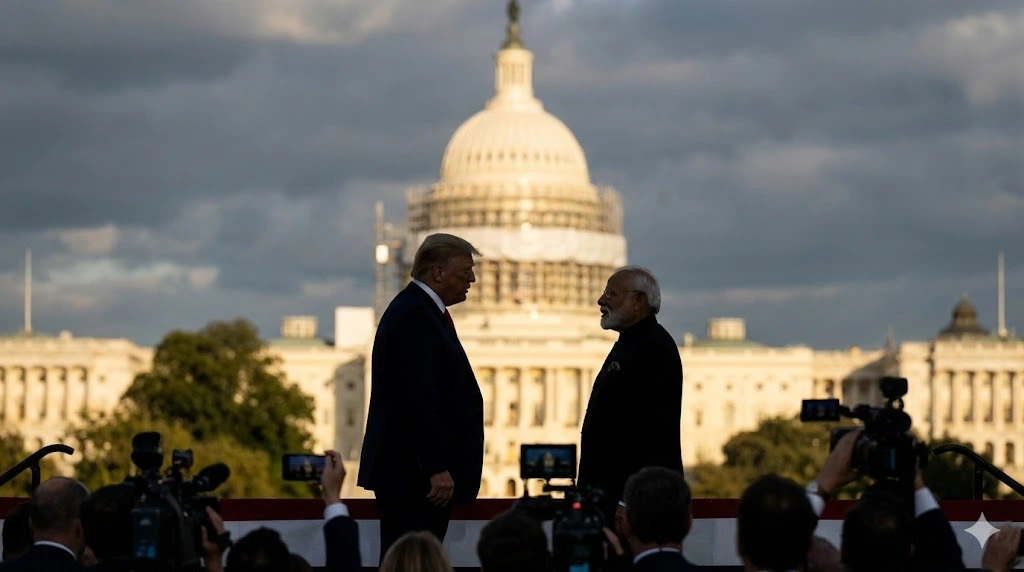
A significant political shift is unfolding in Washington. A bipartisan group of lawmakers—spanning both the Democratic and Republican parties—has openly challenged former President Donald Trump’s tariff policy targeting India. The lawmakers argue that the additional duties imposed on Indian imports are not only damaging US–India relations but are also placing a direct economic burden on American companies, consumers, and supply chains.
Congressional Pushback on Trump’s “National Emergency” Claim
Democratic Representatives Deborah Ross, Mark Veasy, and Raja Krishnamoorthy have introduced a resolution in the US House of Representatives aimed at overturning the “national emergency” declaration used by the Trump administration to justify tariffs of up to 50% on Indian imports.
According to the lawmakers, invoking the International Emergency Economic Powers Act (IEEPA) to impose these tariffs is legally questionable and undermines Congress’s constitutional authority over trade policy. They argue that emergency powers should not be used as a shortcut to enforce unilateral trade decisions.
Tariffs Hurting America More Than India
Lawmakers highlighted that from August 1, a 25% tariff was imposed on select Indian goods, followed by an additional 25% “secondary duty” effective August 27, 2025, pushing total duties to 50%.
The consequences, they say, are already visible. Import costs for several Indian products have nearly doubled, turning the tariffs into what lawmakers describe as an indirect tax on Americans. The impact includes:
-
Rising retail prices
-
Disrupted supply chains
-
Reduced global competitiveness of US industries
Rather than protecting American interests, the tariffs are weakening them.
Strain on US–India Relations
Democratic lawmaker Ami Bera warned that elevated tariffs are creating unnecessary friction in an otherwise strong bilateral relationship. Republican Representative George Holding echoed the concern, emphasizing that trade disagreements should not undermine long-standing cooperation between the two democracies.
There is broad consensus among lawmakers that India remains a critical strategic, economic, and cultural partner for the United States. They argue that diplomacy and negotiation—not pressure tactics—are the only sustainable way forward.
India’s Position: Dialogue Over Confrontation
India’s Commerce Secretary welcomed the bipartisan initiative, reiterating New Delhi’s long-standing position that trade disputes must be resolved through dialogue and cooperation. India’s message remains consistent and clear: partnership over trade wars.
What Does Trump Really Want From India?
The Trump administration has defended the tariffs by citing India’s continued purchase of Russian oil, claiming it indirectly supports Russia’s war effort in Ukraine. This rationale was used to justify the use of emergency economic powers.
However, US lawmakers are now questioning this logic. They ask whether penalizing a strategic partner is the right approach—and whether coercive trade measures can realistically reshape global geopolitics.
The reality, they argue, is that today’s India is not the India of the past. As one of the world’s fastest-growing major economies, India has become a central player in global supply chains and a key alternative to China for American businesses. Attempting to pressure India may ultimately run counter to US long-term interests.
Is Trump Struggling to Accept a New India?
Political analysts suggest that Trump’s “America First” approach often lacks diplomatic balance. By taking a hardline stance against a rising global power like India, Trump may be overlooking a simple truth: trust and cooperation—not confrontation—are the foundation of lasting partnerships.
India is no longer a passive player in global trade negotiations. It negotiates from a position of strength, and any sustainable deal must reflect that reality.
The Road Ahead
If the resolution passes both the House and the Senate, the additional 25% secondary duty will be withdrawn, restoring tariffs to their previous levels. Such a move would likely reinvigorate bilateral trade, encourage investment, support job creation, and strengthen long-term strategic cooperation.
Conclusion
The growing pushback in Congress sends a clear signal: Trump’s tariff policy on India is no longer facing opposition abroad alone—it is increasingly questioned at home. At a time of global economic uncertainty, cooperation between India and the United States is not optional; it is essential. Choosing dialogue over disruption could benefit not just these two nations, but the stability of the global economy itself.