


Explore More Articles:
- NATO, Russia & China Military Analysis 2025
- India & Russia IL-100/IL-76 Collaboration
- Charlie Kirk: Birth to Impact
- Charlie Kirk: Assassination & America Impact
- Video Trends 2025: Global Insights
- Best Countries for Higher Education 2025
- Narendra Modi: Birthday & Achievements
- America Overview: USA Facts & History
- Vladimir Putin: Biography & Global Influence
- Germany 2025: Politics, Economy & Sports
- Australia 2025: Tourism, Cricket & Education
- Thailand Cave Rescue: Miracle Story
- Mona Lisa: Mystery, Theft & Legacy
- Mona Lisa History in Hindi
Click any link to explore related posts & enhance your reading experience!
Description
Discover the complete history, mystery, and secrets of the Mona Lisa — from Leonardo da Vinci’s masterpiece, its 1911 theft, hidden symbolism, to why it is the world’s most famous painting today.
Introduction
The Mona Lisa (Italian: La Gioconda; French: La Joconde) is considered the world’s most famous painting, created by the legendary Italian polymath Leonardo da Vinci in the early 16th century. Today, its estimated value is close to $1 billion, making it not only a priceless work of art but also a cultural icon.
But what makes Mona Lisa so unique? Why did its popularity skyrocket after the 1911 theft? And what hidden mysteries lie behind Lisa’s smile? This article explores the history, identity, secrets, theft, and legacy of the Mona Lisa, in a way that answers these questions and helps you understand why this portrait continues to fascinate the world.
Origins and Creation
Leonardo da Vinci: The Mastermind
Leonardo da Vinci (1452–1519) was not just a painter but also an engineer, scientist, anatomist, architect, and theorist. His knowledge spanned disciplines such as cartography, optics, astronomy, hydrology, geology, and even palaeontology. Among his many works, the Mona Lisa (painted around 1503–1506, with modifications continuing until his death in 1519) became his most celebrated.
The Subject: Who Was Mona Lisa?
For centuries, the identity of the woman in the painting sparked debate. According to Italian biographer Giorgio Vasari (1550), she was Lisa Gherardini, the wife of a wealthy Florentine silk merchant, Francesco del Giocondo. This gave rise to the painting’s alternate names:
- Mona Lisa – Derived from “Madonna Lisa” (Madam Lisa). Over time, “Monna” (with double N) evolved into “Mona” in English.
- La Gioconda – After marriage, Lisa became Lisa Giocondo. In Italian, “Giocondo” means cheerful or joyful, fittingly linked to her famous smile.
- La Joconde – The French adaptation of “Giocondo,” used in the Louvre Museum today.
Some alternative theories claim Mona Lisa could be Leonardo’s mother, a queen, or even a disguised self-portrait of da Vinci. In 1987, artist Lillian Schwartz digitally compared da Vinci’s features with Mona Lisa, sparking the “self-portrait” theory. However, archival research in Florence (2004) by Professor Giuseppe Pallanti confirmed that the sitter was indeed Lisa Gherardini.
Journey to France
If both da Vinci and Lisa were Italian, why is the Mona Lisa in France today? The answer lies in 1516, when French King Francis I invited da Vinci to France. Leonardo carried the painting with him, possibly still unfinished, and kept improving it. After Leonardo’s death in 1519, the painting remained in the French Royal Collection.
Following the French Revolution (1797), the painting was transferred to the Louvre Museum, where it remains today under tight security.
The 1911 Theft
Vincenzo Peruggia: The Italian Patriot
On 21 August 1911, three men (led by Italian handyman Vincenzo Peruggia) hid inside the Louvre overnight. The next morning, they walked out with the painting hidden under a white smock.
Peruggia believed the Mona Lisa rightfully belonged in Italy since Leonardo was Italian. For two years, he kept the painting hidden in his Paris apartment. In 1913, he attempted to sell it to art dealer Giovanni Poggi in Florence. Poggi immediately recognized the stolen masterpiece and informed the police.
Peruggia was arrested and sentenced to six months in prison. The Mona Lisa was safely returned to the Louvre on 4 January 1914.
Impact of the Theft
Ironically, the theft was the turning point in Mona Lisa’s fame. Before 1911, it was admired only within art circles. After the sensational media coverage of its disappearance and recovery, the painting became world-famous, attracting millions of visitors to the Louvre annually.
Artistic Techniques and Secrets
Medium and Size
Unlike most Renaissance paintings, the Mona Lisa is not painted on canvas but on poplar wood. Its dimensions are modest: 77 cm × 53 cm.
Sfumato: The Secret of the Smile
Leonardo used a painting technique called Sfumato (Italian: “soft” or “smoky”), where boundaries are blurred, and colours are smoothly blended. This creates a lifelike effect without visible outlines.
The most striking result of Sfumato is Mona Lisa’s mysterious smile. Depending on where the viewer focuses—her lips or her eyes—the smile appears to change. When viewed directly, the lips look neutral; but from peripheral vision, the shadows suggest a smile.
Anatomical Studies
Da Vinci dissected human corpses and studied facial muscles to perfect the subtle curvature of the lips. His notes compare human expressions even with horses, showing his obsession with capturing natural movement.
Optical Illusion
Leonardo’s research on optics revealed how light spreads across the retina. The fovea captures details, while peripheral vision captures shadows. By exploiting this, he ensured Mona Lisa’s smile appears dynamic, shifting with the viewer’s gaze.
The Isleworth Mona Lisa Debate
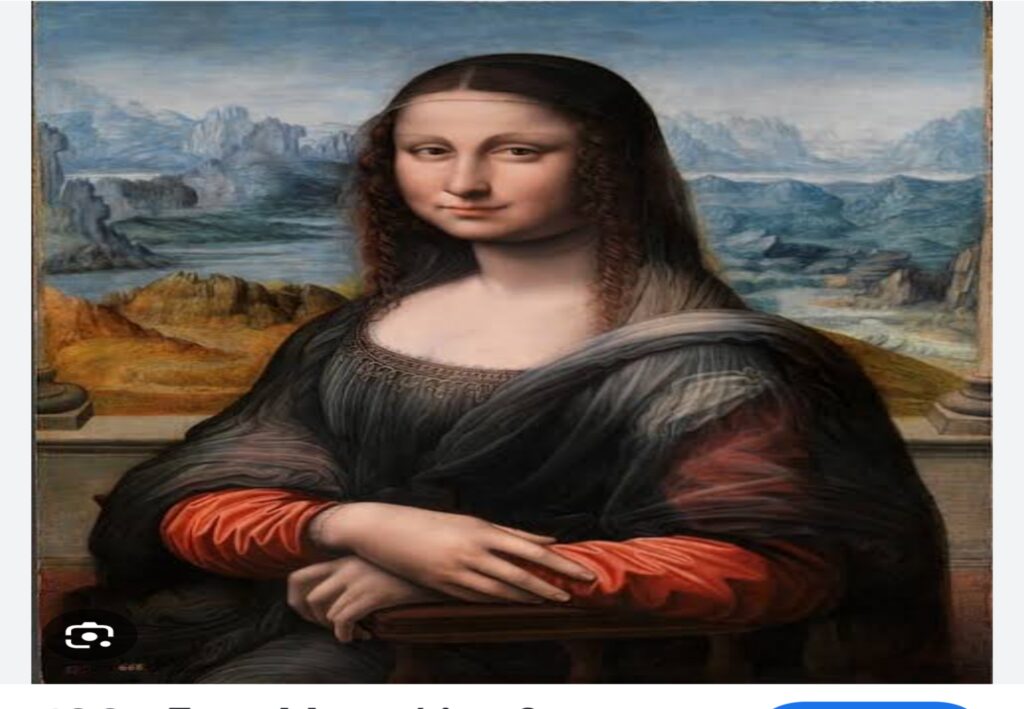
In 1914, an alternative version of the Mona Lisa, known as the Isleworth Mona Lisa, surfaced in London. It depicts a younger-looking woman, with clearer expressions and two columns in the background, similar to a sketch made by artist Raphael.
Two major theories exist:
- Two Mona Lisas Theory – Da Vinci painted both versions: Isleworth as the first attempt, Louvre version as the final masterpiece.
- Workshop Theory – Leonardo painted the face and hands, but his apprentices completed the background.
Despite ongoing debates, no conclusive evidence exists. The Isleworth Mona Lisa remains a fascinating “second Mona Lisa.”
Current Display and Security
Today, the Mona Lisa is displayed at the Louvre Museum in Paris, behind bulletproof glass under strict climate control:
- Temperature: 18–21°C
- Humidity: 50% ±10%
Millions of visitors flock each year to catch a glimpse of the painting, often through a crowd of admirers.
Cultural Legacy
The Mona Lisa is more than just a Renaissance portrait. It has become a global cultural icon, referenced in films, music, literature, and even memes. Its value skyrocketed due to:
- Historical importance (Leonardo’s masterpiece).
- Media attention after the 1911 theft.
- Unique artistic techniques (Sfumato, optical illusions).
- Mysterious aura surrounding the smile.
- 🖼️ Mona Lisa: Numerical and Factual Overview
1️⃣ Creation and Da Vinci’s Contribution
Detail Fact / Number
Artist Leonardo da Vinci (1452–1519)
Creation Period Around 1503–1506 (with modifications until 1519)
Total Estimated Time 12–16 years
Technique Sfumato, Chiaroscuro
Size 77 cm × 53 cm
Panel Poplar wood panel
2️⃣ Smile and Eyes Mystery
Mystery Detail / Number
Smile Angle Changes at 7–10° different viewing angles
Hidden Symbols in Eyes Letters “S” and “L”, 2–3 tiny numbers
Eye Gaze Effect Eyes seem to follow the viewer from any angle
3️⃣ Hidden Painting and Symbols
Element Detail / Number
Hidden Image Another woman’s image under the painting (Pascal Cotte research)
Hidden Symbols Estimated 40+ symbols, including Golden Ratio (φ ≈ 1.618)
Background Inspiration Lecco, Lake Como, Italy
4️⃣ 1911 Theft and Its Impact
Detail Number / Fact
Thief Vincenzo Peruggia (Italian nationalist)
Theft Date 21 August 1911
Recovery 1913 (around 2 years later)
Louvre Visitor Increase 120,000+ visitors in 2 years after the theft
Media Coverage 500+ newspapers reported it
Global Recognition Popularity increased 10 times after the theft
5️⃣ Pop Culture and Media Influence
Area Fact / Number
Books The Da Vinci Code by Dan Brown (2003)
Song Mona Lisa by Nat King Cole (1950)
Films / Ads Referenced in 50+ movies and ads
Internet Searches 50+ million Google searches by 2025
Social Media Posts 1+ million posts on Instagram and TikTok
6️⃣ Economic and Cultural Value
Detail Number / Fact
Estimated Value ~$1 billion
Display Location Louvre Museum, Paris
Annual Visitors ~10 million
Security Bulletproof glass, climate-controlled environment
7️⃣ Scientific and Technical Discoveries
Technique Finding / Number
Multispectral Scanning Revealed multiple hidden layers
Infrared Reflectography Showed initial sketches and changes
3D Modeling Studies Analyzed smile and facial muscle movements
Internal Links
- Leonardo da Vinci
- Louvre Museum
- French Revolution
- Isleworth Mona Lisa
External Links (Authoritative References)
- History.com – The Theft of the Mona Lisa
- Louvre Museum Official Site
- National Gallery – Leonardo da Vinci
Conclusion
The Mona Lisa is not just a painting; it is a symbol of mystery, beauty, science, and history. From Leonardo’s genius to its 1911 theft, from hidden symbolism to its present-day fame, every aspect of the Mona Lisa adds to its legendary status.
More than 500 years later, it continues to puzzle, inspire, and attract millions—making it the undisputed No.1 painting in the world
Quick Mona Lisa FAQ
- Who is she?
Mona Lisa is a mysterious lady in a famous painting by Leonardo da Vinci. People think she was Lisa Gherardini from Italy. - Why is she famous?
Her smile is magical—sometimes it seems happy, sometimes secretive! Plus, the painting looks almost real. - How old is it?
Over 500 years old and still amazing. - Where is it now?
In the Louvre Museum, Paris, behind glass to keep it safe. - Was it ever stolen?
Yes! In 1911, but it was safely returned two years later. - Why should I care?
It’s a masterpiece of art—beautiful, mysterious, and full of history.