


Most of us see a mosquito as nothing more than an irritating insect. But in a surprising twist of science, that tiny creature has just helped researchers unlock a powerful new way to 3-D print at an incredibly small scale.
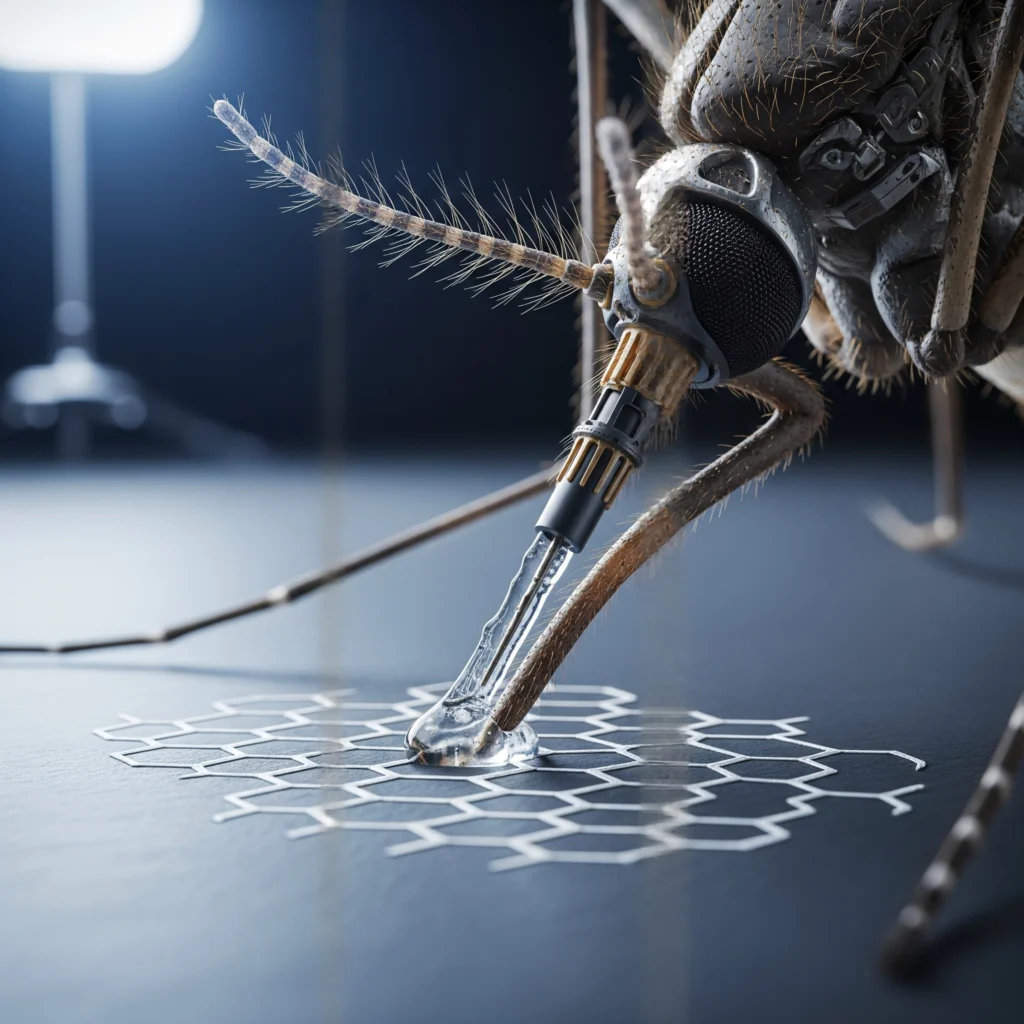
In a study published on November 21 in Science Advances, scientists revealed that a mosquito’s proboscis—the long, needle-like organ it uses to pierce skin—can serve as an exceptionally precise nozzle for 3-D printing. The researchers call this breakthrough “3-D necro printing.”
What is 3-D necro printing?
The term comes from necrobiotic, an emerging field where biological parts from animals are repurposed for advanced machines. In earlier experiments, scientists famously used dead spider legs as robotic grippers. Now, the focus has shifted to something even more delicate: the mosquito proboscis.
By using this natural structure as a printing nozzle, researchers were able to print lines as thin as 20 micrometers—about half the width of a fine human hair. That level of precision is extremely difficult and expensive to achieve with conventional, engineered printer tips.
Why a mosquito?
Led by mechanical engineer Changhong Cao at McGill University in Montreal, the research team explored many biological structures found in nature—stingers, fangs, and harpoon-like organs—to see if they could replace traditional print nozzles.
They ultimately zeroed in on the proboscis of the female Aides aegypti mosquito. The choice was not accidental:
-
The proboscis is remarkably straight
-
Its inner diameter ranges from 10 to 20 micrometers
-
It is strong enough to withstand high pressure
-
It is naturally designed to deliver fluids with extreme precision
In other words, evolution had already engineered an ideal micro-scale nozzle.
Printing at an extraordinary scale
Using the mosquito proboscis, the team successfully printed intricate shapes, including a honeycomb pattern, a maple-leaf outline, and a microscopic scaffold designed to hold biological cells. All of these were printed using commercially available bio inks.
Each printed line measured around 18–20 micrometers wide, far thinner than what most commercial 3-D printer nozzles can achieve.
Why existing printers weren’t enough
Initially, the researchers hoped to simply attach the proboscis to a commercially available 3-D printer. But they quickly ran into a problem: pushing ink through such a tiny biological structure required higher pressure than standard printers could handle.
So they built a custom system instead. The proboscis was reinforced with a 3-D-printed resin coating and connected to an engineered tip, creating a continuous and stable pathway for the ink to flow.
Better than engineered materials?
According to coauthor Jianyu Li, a biomaterials engineer at McGill, the mosquito proboscis outperforms even the best commercial dispense tips, which typically have inner diameters of 35 to 40 micrometers—roughly twice as wide.
“This nature-derived structure is simply better suited for this scale than most engineered materials,” Li says.
Making advanced 3-D printing more accessible
Daniel Preston, a mechanical engineer at Rice University who was not involved in the study, points out that ultra-fine dispensing tips are often expensive and difficult to manufacture.
Using biological parts that already exist in nature could help lower costs and remove barriers, making high-precision 3-D printing more accessible to researchers around the world.
In his words, this approach could “democratize” micro-scale 3-D printing.
A future in medicine
The implications go far beyond printing tiny shapes. Li’s lab is now exploring how mosquito proboscises could be used as microneedles for drug delivery. Such needles could deliver medications painlessly and with extraordinary precision, opening new possibilities in biomedical engineering and targeted therapies.
Learning from nature
This research is a powerful reminder that nature, refined by millions of years of evolution, often solves problems that human engineering still struggles with. A structure designed for something as simple—and annoying—as a mosquito bite may soon help shape the future of medicine, materials science, and micro-engineering.
Sometimes, the smallest creatures inspire the biggest innovations.