


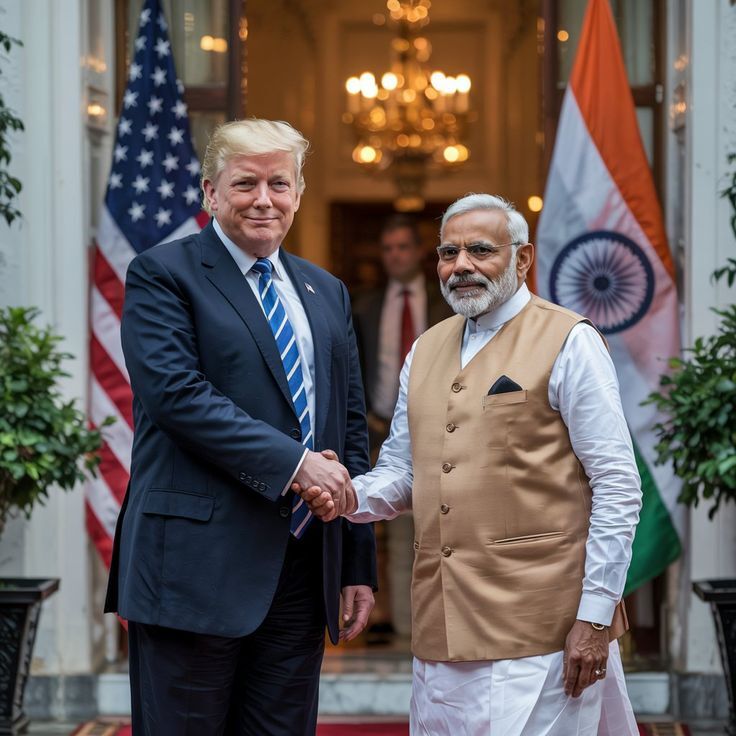
The long-pending India–US trade deal has reached a decisive stage where its impact will go far beyond commerce. What began as a negotiation over tariffs and market access is now shaping up to be a key factor in global politics and economic power dynamics. After months of tough negotiations, multiple rounds of talks, and unresolved tariff disputes, strong signals are emerging that the agreement may soon move toward a concrete outcome.
Adding to its significance, a high-level US delegation is set to visit India next week. The primary focus of this visit will be final negotiations on unresolved issues such as tariffs, market access, agricultural imports, digital trade, and import-export regulations.
Why the US Delegation’s India Visit Is So Important
Diplomatic experts believe that the final face-to-face discussions often determine whether a trade deal is sealed or collapses. The fact that senior US officials are traveling to India clearly indicates that:
-
The US no longer sees India merely as a “large consumer market”
-
India is now viewed as a strategic economic partner
-
This shift reflects both American necessity and long-term strategy
For Washington, engaging India directly has become unavoidable.
Six Rounds of Talks: Agreements Reached, But With Firm Conditions
So far, six rounds of negotiations have taken place between India and the US. While consensus has been achieved on several technical aspects, certain key issues have remained unresolved because India has refused to compromise on its core interests.
India’s Clear and Non-Negotiable Priorities
From the beginning, India has firmly stated that:
-
Farmers’ interests will not be compromised
-
Protection of MSMEs (Micro, Small and Medium Enterprises) is non-negotiable
-
Any deal harming domestic industries is unacceptable
This strong stance has gradually influenced the US position. American negotiators are now realizing that any meaningful agreement with India can only succeed by respecting India’s terms.
Why Has the US Softened Its Stance? Politics, Not Just Trade
A deeper analysis reveals that the US shift is driven less by trade and more by geopolitics.
1️⃣ Modi–Putin Factor

India’s long-standing relationship with Russia—and the strong personal rapport between Prime Minister Narendra Modi and President Vladimir Putin—has become a strategic concern for the US.
Washington understands that:
-
If India continues strengthening ties with Russia
-
And the US applies only trade pressure
-
The global balance of power could tilt away from American interests
As a result, flexibility on the trade front has become a strategic necessity.
2️⃣ China and the Indo-Pacific Strategy
China’s rising economic and military power has made India indispensable to US strategy in the Indo-Pacific region. Without India’s cooperation:
-
The Indo-Pacific vision would lose momentum
-
US influence in Asia would weaken significantly
This strategic reality explains the more pragmatic and flexible approach now visible from the Trump administration.
India’s Domestic Focus: Strategy, Not Compulsion
India has evaluated the trade deal not just from a global standpoint, but also through the lens of domestic economic stability.
🌾 Farmers and Agriculture
For India, agriculture is not merely a trade sector—it supports livelihoods and social stability. Unrestricted entry of cheaper US agricultural products could:
-
Harm domestic farmers
-
Create long-term rural distress
This is why India remains cautious on tariff reductions in agriculture.
🏭 MSME Sector Protection
MSMEs form the backbone of India’s economy by:
-
Generating large-scale employment
-
Supporting domestic manufacturing
India aims for a deal that opens new global opportunities for MSMEs rather than exposing them to unfair competition.
If the Deal Happens, What Will Change?
A successful agreement could bring far-reaching benefits:
-
Resolution of long-standing tariff disputes
-
Sharp growth in bilateral trade
-
Better US market access for Indian startups and tech firms
-
Increased US investment and technology transfer to India
-
A stronger role for India in global supply chains
For the US, India could emerge as a reliable alternative to China in critical supply networks.
Challenges Still Remain
Despite positive momentum, hurdles have not disappeared. Key concerns include:
-
Agricultural imports
-
Digital trade regulations
-
Data protection
-
Intellectual Property Rights (IPR)
Finding a balanced solution on these issues will be the real test of this agreement.
Conclusion: This Is Not Just a Trade Deal, It’s a Signal of India’s Rising Power
The India–US trade negotiations clearly show that India is no longer a nation that signs agreements under pressure. Today, India:
-
Sets its own terms
-
Influences global power equations
-
Forces major world powers to rethink strategy
The Modi government’s diplomatic balance between East and West, strong economic confidence, and strategic independence have placed India at a position where no major decision can be taken without its involvement.
All eyes are now on the coming week.
Will this deal remain just another headline—or will it become a landmark in global economic and political history?