


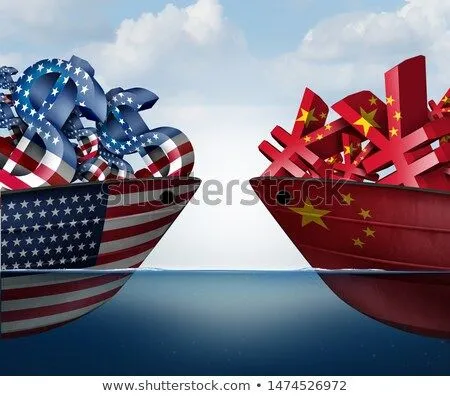
Introduction: A New Global Reality
The trade and technology war between the United States and China has shaken the foundation of the world economy.
This is not just about import tariffs or export limits — it’s a fight for global leadership in the 21st century.
Recent months have seen the U.S. raise tariffs up to 100% on key Chinese goods, while China has tightened control over rare earth minerals, vital for semiconductors, EVs, and defense systems.
This rivalry has started to reshape the global order — moving from globalization to a block-based economy built on “friend-shoring” and “near-shoring”.
Every nation today stands at a crossroads — either suffer from this storm or use it as a golden opportunity to redefine its economic destiny.
I. How the World Is Getting Hit
The U.S.–China clash has a chain effect. From chip makers to farmers, and from Asian suppliers to Western consumers — everyone is feeling the heat.
- Directly Affected Economies
Semiconductor Giants (Taiwan & South Korea):
These countries supply chips to both U.S. and China. Trade restrictions mean a risk of losing one of their biggest markets, creating supply shocks and unstable revenues.
Example: Taiwan’s TSMC and South Korea’s Samsung are now facing tighter U.S. export rules and rising costs.
American Consumers:
Higher tariffs = higher prices.
Everyday products — phones, laptops, and household goods — are now costlier, pushing inflation up and reducing purchasing power in the U.S.
U.S. Farmers:
China’s counter-tariffs have hurt American agriculture badly, especially soybeans and meat exports. Farmers are now searching for smaller, less-profitable markets.
Mexico & Canada:
As close trade partners under USMCA, they face indirect shocks from higher input costs and raw material shortages.
- Wider Global Impact
European Union (EU):
EU nations are major trade partners of both the U.S. and China. The slowdown and financial market stress have hit European exports and forced them to choose sides on technology standards (like 5G and AI).
Developing Nations:
Countries in Africa and Latin America relying on Chinese loans and cheap imports now face funding cuts and slower project growth due to China’s internal slowdown.
II. Who Can Turn This Crisis into an Opportunity
Despite global tension, some smart nations are turning the trade war into a growth moment.
They are filling the gaps left by China’s supply-chain slowdown.
- India 🇮🇳 — The Rising Manufacturing Hub
Why India Gains:
With its democratic system, young English-speaking workforce, and huge domestic market, India has become the first choice for companies diversifying away from China.
Its Production Linked Incentive (PLI) schemes are attracting global players in electronics and pharma.
Apple, Samsung, and Foxconn have already expanded operations in India.
Business Insider – Apple’s India Export Surge (2025)
Long-Term Edge:
India’s neutral foreign policy and growing tech skills make it a safe and reliable destination for U.S. and European investors.
- Vietnam 🇻🇳 — Fastest Growing Factory of Asia
Reason for Success:
Vietnam has built a strong export-oriented economy with low labor costs and quick policy reforms.
Its closeness to China allows easy access to raw materials.
The country has signed major trade deals like CPTPP, giving investors tariff-free access to global markets.
RMIT Vietnam Report on Trade Shifts (2025)
- Mexico 🇲🇽 — The Gateway to North America
Near-Shoring Advantage:
Because of its border with the U.S., many companies are moving production from Asia to Mexico.
The USMCA Agreement ensures tariff-free access to the North American market — ideal for autos and electronics.
Policy Circle – US-China Trade War Benefits Mexico (2025)
- Indonesia & Thailand 🇮🇩🇹🇭 — The Emerging Industrial Powerhouses
Both countries are drawing attention for their large workforce, strategic location, and stable growth.
Multinationals are setting up new assembly units for electronics, textiles, and automotive components.
- Australia & Canada 🇦🇺🇨🇦 — New Resource Partners
China’s control over rare-earth minerals has forced the U.S. and its allies to look for reliable suppliers.
Australia and Canada are now becoming trusted sources for lithium, cobalt, and nickel — vital for EVs and clean energy.
Reuters – China Tightens Rare Earth Exports (Oct 2025)
III. The Five-Step Action Plan for Every Country
To gain from this global shift, nations need a clear, realistic strategy.
Here’s a five-point roadmap for governments and businesses:
- Build Reliable Supply Chains
Simplify investment rules and reduce red tape.
Create a National Supply Chain Reliability Index to measure logistics speed, port efficiency, and policy stability.
Encourage “China +1” and “Friend-Shoring” models.
- Invest in Energy and Infrastructure
Improve ports, roads, and cargo systems for faster, cheaper transport.
Focus on renewable energy — solar, wind, green hydrogen — as investors now demand carbon-neutral production.
- Develop Skilled Workers and Tech Capability
Train youth in AI, robotics, coding, and smart manufacturing.
Build strong data security laws and support local innovation in hardware and software.
- Maintain Balanced Global Relations
Stay neutral — trade with both the U.S. and China where possible.
Sign Free Trade Agreements (FTAs) with the EU, UK, Japan, and other key economies.
- Strengthen Domestic Markets
Boost middle-class spending power to create a stable internal demand.
Encourage “Make for the World, Make for Home” industries to ensure growth even in global downturns.
IV. Why This Matters to Every Country
More Jobs and Investments:
New factories, logistics hubs, and tech parks mean millions of fresh jobs and FDI inflows.
Diversified Global Economy:
Less dependence on any one country (like China) means fewer global shocks.
Better Innovation:
Competition between regions will drive more R&D, new products, and new technologies.
Green and Sustainable Growth:
Countries focusing on clean energy and ethical production will attract long-term global capital.
Conclusion: The World at a Crossroads
The US-China Trade War is not just an economic fight — it’s a reset button for the world.
The nations that act quickly — by building reliable supply chains, investing in technology, and keeping policies stable — will lead the next decade.
This is not the end of globalization; it’s the beginning of smarter globalization.
The world is shifting from dependence on one superpower to shared growth among many reliable nations.
Those who move fast, think smart, and stay trusted will not only survive — they will define the new world economy.
Verified Sources (2025):
- Reuters – China Tightens Rare Earth Export Controls (Oct 2025)
- Business Insider – Apple’s India Export Rise Amid US-China Tariffs (July 2025)
- RMIT Vietnam – Trade War Shifts and Gains (Feb 2025)
- Policy Circle – India and Mexico Gain from Trade War (2025)
- CSIS – Mapping Semiconductor Supply Chains in Indo-Pacific (2025)